

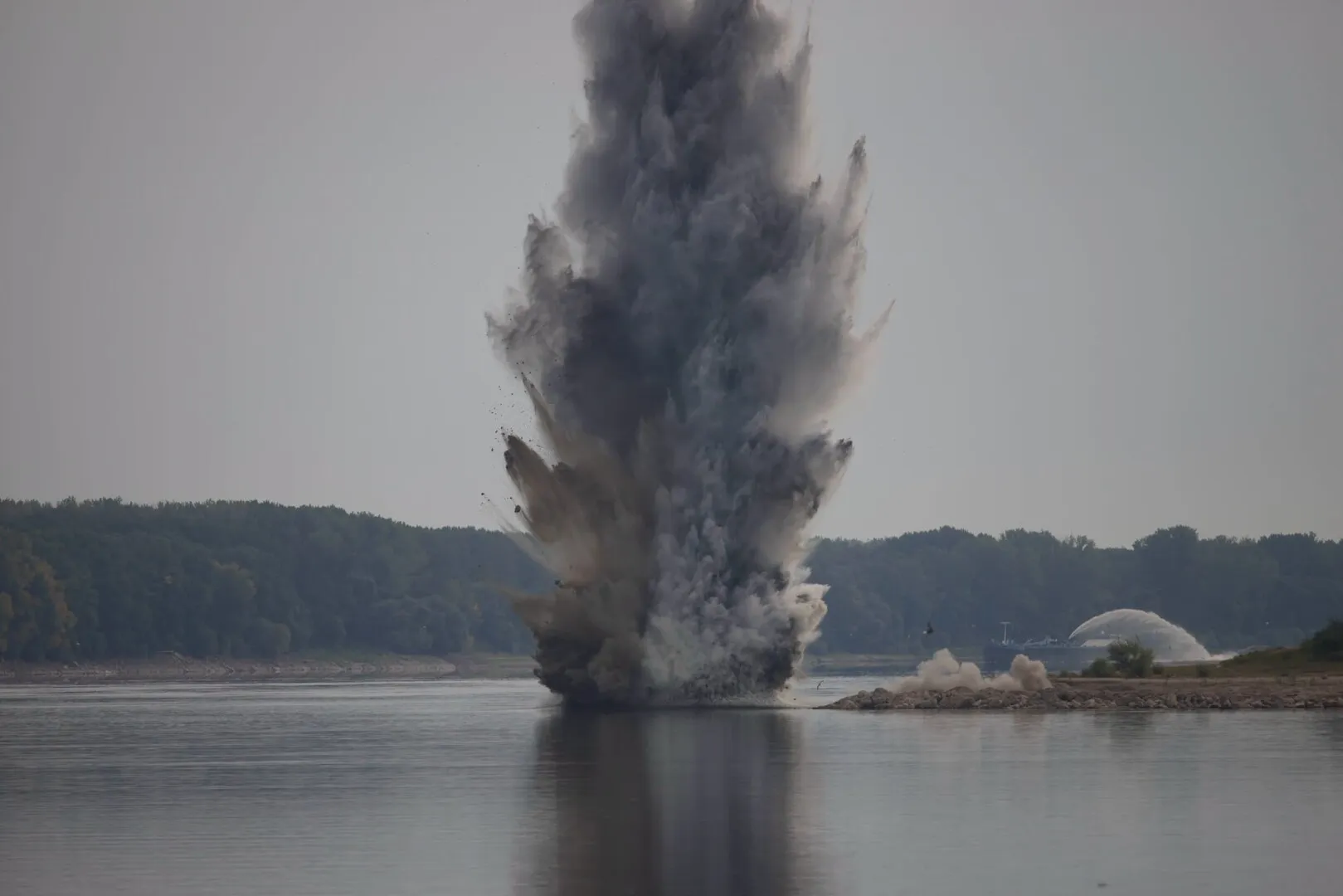
The Romanian Army has successfully dislodged the submerged Pârjoaia rock formation from the Bala branch of the Danube in an unprecedented operation intended to improve water flow towards the Cernavodă Nuclear Power Plant.
Romanian Defence Minister Radu Miruță announced on Monday, August 3, that the controlled underwater explosion had achieved its immediate objective. The intervention involved specialists from both the Romanian Land Forces and Naval Forces and followed a preliminary test designed to determine the appropriate quantity and placement of explosives.
“This was a complicated operation because the explosives had to be placed underwater,” Miruță explained.
Emergency Intervention amid Falling Danube Levels
The operation was organised as water levels on the Danube continued to fall, creating the risk that the Cernavodă Nuclear Power Plant could no longer receive the water flow required for its operation.
According to the initial technical estimates presented by the minister, without an emergency intervention, the nuclear plant could have been forced to begin shutdown procedures as early as Wednesday or Thursday.
Miruță said that every additional day during which the plant remains operational after that point represents a measurable benefit for Romania’s energy system. He estimated that one additional day of production at Cernavodă is approximately three times more financially valuable than the total cost of the intervention.
Rock Fragments to Be Removed from the Danube
The explosion represents only the first stage of the operation. The dislodged rock fragments must now be extracted from the riverbed using two barges and a high-capacity crane.
Authorities will remove as much of the fragmented rock as technically possible over the following hours and days. Specialists from the Romanian Waters administration will then evaluate the results and determine how the extracted material should be managed.
The operation is also expected to improve navigation and facilitate future dredging work along the Bala branch and the Old Danube.
Bala Branch Diverts Most of the Danube’s Water
The intervention addresses a long-standing problem involving the distribution of water between the Bala branch and the Old Danube.
According to the defence minister, approximately 85% of the Danube’s flow currently enters the Bala branch, while only around 15% continues through the Old Danube, which supplies the Cernavodă area.
A broader infrastructure project was supposed to raise the riverbed level along the Bala branch and dredge the Old Danube to improve water distribution. Miruță said the project had remained blocked at the Ministry of Transport since April 2024, forcing authorities to resort to an emergency solution.
First Successful Operation of Its Kind
Romanian authorities had attempted to remove the Pârjoaia rock formation in previous years, but those efforts failed.
Before carrying out the main explosion, military specialists conducted a test blast and analysed its effects. The Land Forces and Naval Forces subsequently adjusted the intervention plan, allowing the rock to be successfully dislodged.
The final impact on the distribution of the Danube’s flow will be established after the rock fragments are removed and new measurements are conducted. However, officials described the successful underwater explosion as an essential step towards maintaining navigation, facilitating dredging and reducing the immediate risk faced by the Cernavodă Nuclear Power Plant.

