

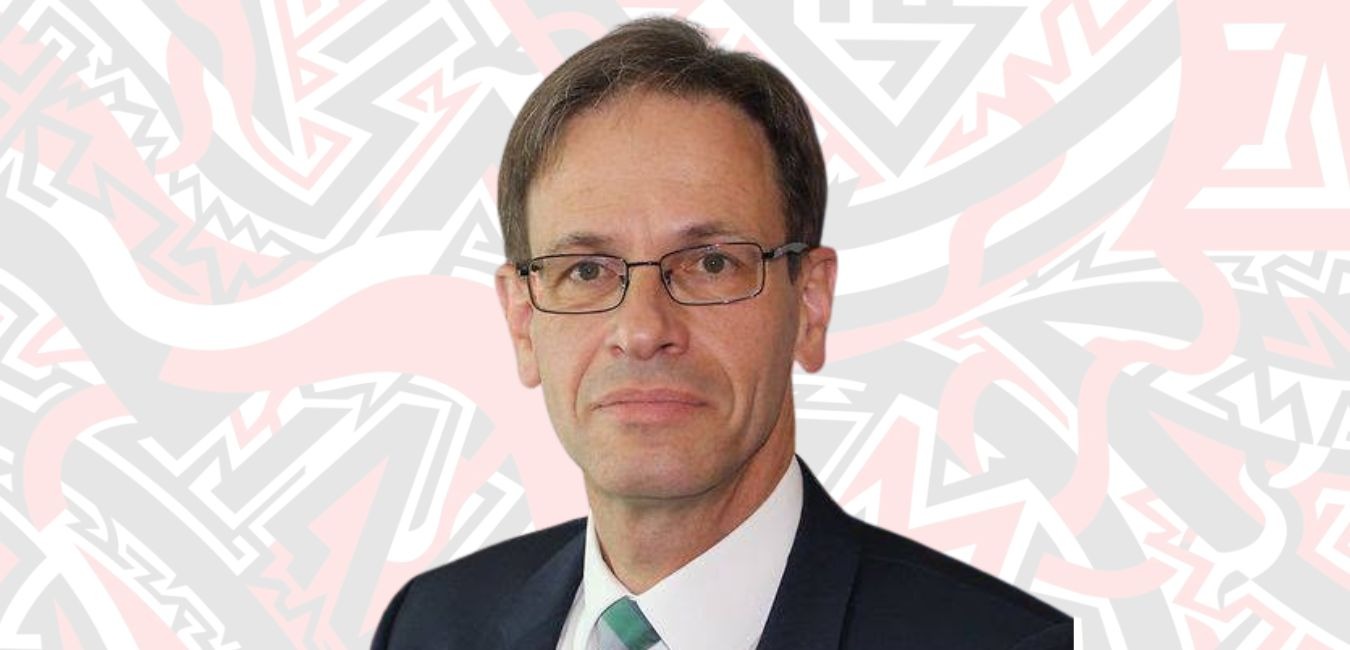
A single television interview has sparked an unnecessary diplomatic dispute among Romania, the Republic of Moldova, and Germany after Berlin’s ambassador in Chișinău appeared to question whether Romanians and Moldovans share the same language and religious heritage.
Hubert Knirsch, Germany’s ambassador to the Republic of Moldova, made the controversial remarks during the July 9 edition of Jurnal TV’s Cabinetul din umbră – The Shadow Cabinet. The discussion concerned a possible future union between Romania and the Republic of Moldova, but the diplomat’s answer quickly shifted the debate from sovereignty and European integration to language, identity, and religion.
The result was a diplomatic own goal. The ambassador’s words provoked criticism on both banks of the Prut, forced the German diplomatic mission to issue explanations and prompted a firm reaction from the Romanian Embassy in Chișinău.
What German Ambassador Hubert Knirsch Said
During the interview, moderator Vitalie Călugăreanu referred to Romania and the Republic of Moldova as two countries that had once been part of the same state and shared the same language, culture, traditions, and religion.
Knirsch initially offered a conventional diplomatic answer regarding a possible union. He said that Romania and the Republic of Moldova were sovereign states and that any decision concerning unification belonged exclusively to their citizens.
The controversy began with what followed.
According to the simultaneous Romanian translation broadcast during the programme, Knirsch said he would question the claim that Romania and the Republic of Moldova had the same language and religion. He then appeared to suggest that while some people believed there was one language, others might believe there were two languages or that there were different religions.
The formulations immediately created the impression that Germany’s ambassador was treating the existence of a common Romanian language as a matter of individual opinion rather than an established linguistic and constitutional fact.
For Romania and for a significant part of Moldovan society, this was not an innocent semantic distinction. It touched one of the most politically sensitive subjects in the region: the Soviet-era doctrine that Moldovans constitute a nation fundamentally separate from Romanians and speak a language different from Romanian.
The Translation Explanation
After the backlash intensified, Knirsch said that his message had been distorted by errors in the simultaneous translation.
According to his clarification, he had intended to say that the Republic of Moldova includes citizens who speak the same language as Romanians, citizens who speak two languages and people belonging to different religious communities.
He argued that the expression “but also other people” had been translated as “others think differently”, while the reference to “people who speak two languages” had been rendered as the existence of “two languages”.
The ambassador said he had not intended to question Romanian linguistic unity or the Orthodox Christian faith. He nevertheless acknowledged that his phrasing should have been clearer and accepted responsibility for the public concern the interview had created.
The clarification substantially changes the literal meaning attributed to his initial remarks. Recognising that the Republic of Moldova has linguistic, ethnic and religious minorities is legitimate and consistent with European principles.
However, it does not entirely resolve the diplomatic problem.
An ambassador operating in Chișinău is expected to understand that references to “two languages” or competing linguistic identities can be immediately interpreted through the lens of Soviet identity engineering. Even when the controversy originates in part from translation, the diplomat remains responsible for ensuring that his position cannot be easily confused with narratives promoted for decades by Moscow.
Romania Rejects Any Relativisation of the Common Language
The Romanian Embassy in Chișinău responded by reaffirming that Romania and the Republic of Moldova share a documented history, a common language and a well-established cultural and spiritual heritage.
The embassy described statements that relativise or question these realities as regrettable and lacking factual foundation. It also warned that ambiguous messages concerning language and identity could be exploited by hostile actors, particularly Russia, to weaken Moldova’s democratic resilience and European orientation.
Romania’s intervention was carefully formulated. It did not challenge the sovereignty of the Republic of Moldova, nor did it claim that all Moldovan citizens share the same ethnic or religious identity.
Instead, it drew a distinction between respect for Moldova’s internal diversity and the historical or political reinvention of the Romanian language as two separate languages.
That distinction is essential.
The Republic of Moldova is a sovereign and multi-ethnic state. Its citizens have the right to identify as Moldovan, Romanian, Russian, Ukrainian, Gagauz, Bulgarian or otherwise. They also have the right to practise different religions or none.
None of this changes the linguistic fact that Romanian is the state language.
Romanian Is Moldova’s Official Language
The question of the official language is not legally unresolved in the Republic of Moldova.
In December 2013, the Constitutional Court ruled that the reference to the Romanian language contained in Moldova’s Declaration of Independence prevailed over the former constitutional wording referring to the “Moldovan language”.
The court also cited the position of Moldova’s Academy of Sciences, which had concluded that the correct scientific name of the state language was Romanian.
In March 2023, the Moldovan Parliament adopted legislation replacing references to the “Moldovan language”, the “state language” and the “official language” with the term “Romanian language” throughout the country’s legislation.
Citizens may continue to describe their regional, cultural or national identity as Moldovan. However, presenting Romanian and “Moldovan” as two separate languages is no longer compatible with Moldova’s constitutional and legislative framework.
This is why the translated version of Knirsch’s remarks triggered such a strong reaction. It appeared to reopen a matter already settled through linguistic research, constitutional jurisprudence and legislation.
Why “Moldovanism” Remains an Explosive Subject
The controversy cannot be understood without the history of Bessarabia under Russian and Soviet rule.
After the Soviet occupation, authorities systematically promoted the idea that Moldovans were a separate people from Romanians and that their language was distinct from Romanian. The Cyrillic alphabet was imposed, Romanian cultural connections were restricted, and expressions of Romanian national identity were frequently treated as politically dangerous.
This policy was not a neutral effort to protect regional identity. It formed part of a broader strategy intended to detach the population between the Prut and the Dniester from Romania and integrate it into the Soviet political and cultural system.
The legacy of that strategy remains visible in the Republic of Moldova. Language and identity continue to be used in electoral campaigns, Russian propaganda and disputes over the country’s geopolitical direction.
For pro-Russian political movements, the theory of a separate Moldovan language helps construct a national identity deliberately positioned against Romania. For unionists, recognising Romanian identity and the common language is central to correcting the historical consequences of Russian and Soviet rule.
A Western ambassador entering this debate must therefore exercise exceptional precision.
A Gift to Russian Propaganda
The most serious consequence of Knirsch’s intervention was not its offence to Romanian public opinion. It was that the ambiguity could easily be converted into propaganda.
Russia has repeatedly used linguistic and ethnic subjects to deepen divisions inside the Republic of Moldova. Moscow’s narratives depict Romania as an expansionist power, portray Romanian cultural influence as a threat and claim that European integration could destroy Moldova’s separate identity.
An apparently similar message delivered by the ambassador of a major European state becomes valuable material for those campaigns.
Pro-Russian commentators can cite the controversy as evidence that even Germany considers the Romanian language question unsettled. Anti-European forces can argue that Western governments are inconsistent, opportunistic or poorly informed about Moldova. Unionist politicians, meanwhile, can claim that European diplomats are prepared to sacrifice historical truth for political convenience.
Whether the ambassador intended any of these interpretations becomes secondary. In diplomacy, the effects of a statement are often more important than the intention behind it.
The Problem With the Religious Argument
The religious component of the discussion also required greater precision from both the moderator and the ambassador.
Romania and the Republic of Moldova share a predominantly Orthodox Christian tradition and a common spiritual heritage. However, neither country is religiously uniform.
Moldova includes Orthodox Christians belonging to ecclesiastical structures connected to either the Romanian Patriarchate or the Moscow Patriarchate, as well as Catholics, Protestants, Jews, Muslims, and people with no religious affiliation.
The moderator’s claim that the two countries simply have “the same religion” was therefore an overgeneralisation. Knirsch was entitled to recognise Moldova’s religious diversity.
The mistake was allowing a legitimate point about minorities to become entangled with the separate and politically explosive question of whether Romania and Moldova share the Romanian language and a common cultural history.
A more competent diplomatic answer would have distinguished immediately between the common heritage of the majority population and the individual rights of every minority.
Berlin’s Eastern European Blind Spot
The incident also exposes a recurring weakness in Western diplomacy towards Eastern Europe.
Western officials sometimes approach identity disputes as if they were ordinary disagreements over terminology, regional dialects or multicultural representation. In countries affected by imperial occupations, forced assimilation and state-directed identity reconstruction, words carry a different political weight.
Expressions such as “Moldovan language”, “two languages” or “separate people” cannot be separated from the policies by which the Russian Empire and the Soviet Union sought to redefine the population of Bessarabia.
Germany has strongly supported Moldova’s European integration and has condemned Russian aggression and disinformation. Its representatives should therefore be particularly careful not to reproduce, even unintentionally, the vocabulary used by Russian influence operations.
The ambassador’s explanation suggests that the scandal was produced by an unfortunate combination of unclear phrasing, simultaneous translation and an extremely sensitive subject. That may absolve him of the more serious accusation of deliberately promoting Soviet-style Moldovanism.
It does not absolve him of diplomatic carelessness.
Romania and Moldova Need Clarity, Not Imported Ambiguity
Romania’s relationship with the Republic of Moldova is not based solely on contemporary political cooperation. It is built on a shared language, overlapping history, family connections, cultural institutions and a strategic partnership that has become increasingly important following Russia’s invasion of Ukraine.
Germany is also an essential partner for both states. Berlin supports Moldova’s European path and remains one of the most influential capitals inside the European Union.
Precisely because these relationships matter, ambiguity on fundamental subjects is dangerous.
Respecting Moldova’s sovereignty does not require questioning the Romanian language. Recognising minorities does not require presenting scientific and constitutional facts as competing opinions. Supporting European values does not mean ignoring the historical methods through which authoritarian regimes manufactured artificial identities.
The German ambassador was correct on one essential point: only the citizens of Romania and the Republic of Moldova can decide whether the two states should ever unite.
But that political choice must not be confused with the factual question of the language they share.
A Diplomatic Failure That Should Not Be Repeated
Hubert Knirsch eventually accepted responsibility for the confusion and offered a plausible explanation concerning the translation. That clarification should be acknowledged.
However, the episode remains a serious diplomatic failure.
An experienced ambassador should have anticipated that an improvised intervention involving Romanian identity, the state language of Moldova, religion, and unification could not be addressed with vague formulations in the final minutes of a televised interview.
The controversy has strained trust, energised political radicals and created an opening for Russian propaganda at a time when the Republic of Moldova faces sustained pressure from Moscow.
Diplomacy is supposed to reduce ambiguity between partners. In this case, it created it.
For Berlin, the lesson should be straightforward: representatives sent to Eastern Europe must understand not only the current political landscape but also the region’s historical vocabulary.
In Romania and the Republic of Moldova, identity was not shaped only through cultural debate. It was repeatedly attacked through occupation, repression and propaganda.
Treating that history carelessly is not sophisticated diplomacy. It is an avoidable and potentially damaging mistake.

