

Romania’s capital market has reached a symbolic and uncomfortable milestone: the Bucharest Stock Exchange is trading at its highest level in history, even as the country faces a weaker currency, political instability, fiscal pressure, and long-running questions about who actually controls some of its most strategic economic assets.
The BET index, the main benchmark of the Bucharest Stock Exchange, opened Friday’s trading session at a new intra-day record of around 29,617 points, slightly above the previous high reached in February. The move came after a strong five-day advance of more than 4.7%, confirming that investors are still buying Romanian listed companies despite the turbulence around them.
The paradox is obvious. The leu is under pressure. Romania’s political scene is unstable. Bond yields remain high. The fiscal deficit continues to worry investors. Yet the stock market is climbing.
This is not just a market story. It is a much deeper Romanian story.
The Market Is Rising While the State Looks Weak
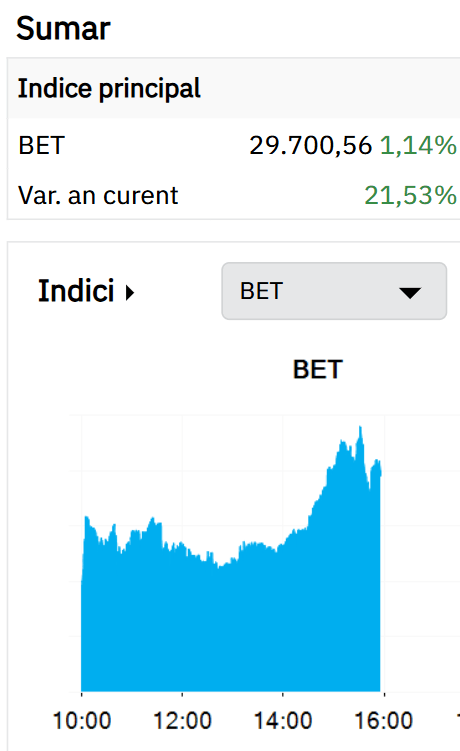
The first explanation is simple: the stock exchange is not the Romanian state. It is not Parliament, not the Government and not the bureaucracy that investors often associate with unpredictability. The BET index is built around companies that generate cash, pay dividends and, in many cases, operate in sectors with strategic importance: banking, energy, utilities, gas, electricity and infrastructure.
That is why the market can rise even when the political context deteriorates.
Banca Transilvania remains the most important company in the BET index, followed by heavyweights such as OMV Petrom, Romgaz, Hidroelectrica and Transgaz. These are not speculative names. They are companies tied to Romania’s financial system, energy production, natural gas, electricity and national infrastructure.
In other words, investors are not necessarily betting on Romanian politics. They are betting on Romanian assets. And that distinction matters.
The OMV Petrom Paradox
The “wow” part of this story is not only that the Bucharest Stock Exchange is at a record high, but also that it is at a record high. It is one of the major forces behind Romania’s market value, which is still OMV Petrom, a company that remains deeply Romanian in its assets, operations and economic importance, but is majority controlled by Austria’s OMV.
OMV holds just over 51% of OMV Petrom, while the Romanian state holds a little over 20%. Romanian pension funds, local investors and other Romanian entities also hold significant stakes, but strategic control is not in Bucharest.
This is the uncomfortable contradiction: Romania’s stock market celebrates the value created by companies tied to national resources, while the country still bears the consequences of past decisions that moved key strategic assets outside majority Romanian control.
Petrom is still central to Romania’s economy. It is listed in Bucharest. It pays taxes in Romania. It is a major energy player. But the controlling shareholder is not the Romanian state.
That makes the current stock market rally politically sensitive. The BET index is not only a financial chart. It is also a mirror of Romania’s economic model: valuable assets, strong companies, high dividends, but often limited national control.
Why Investors Are Still Buying
There are several reasons why the BET index can, at least temporarily, ignore the depreciation of the leu and the political noise.
First, many Romanian listed companies are dividend-driven. Investors are attracted to cash distributions, especially in a high-inflation, high-interest-rate environment. Energy companies, utilities and banks can remain attractive even when the broader macroeconomic picture is unstable.
Second, the fall of the leu can have mixed effects. It hurts importers and can feed inflation, but some companies with export exposure or revenues linked to international prices may be partially protected. The impact is not uniform across the market.
Third, institutional investors may view Romanian equities as relatively cheap compared with other markets, especially when measured by dividend yields and earnings. In a region where uncertainty is no longer exceptional, Romania still offers listed companies with strong balance sheets and exposure to infrastructure, energy and banking.
Fourth, the political crisis may already be priced differently in equities than in the currency market. The leu reacts directly to confidence, capital flows and central bank policy. The stock market reacts to company earnings, dividends and sector expectations.
That is why the currency can fall while the equity market rises.
Premier Energy, Romgaz and Electrica Push the Index Higher
The latest rally has been driven by strong performances from several energy-related names. Premier Energy, Romgaz and Electrica were among the strongest performers of the week, with some reporting double-digit gains.
This is another important signal. Investors are not simply buying “Romania” as a generic story. They are buying sectors where demand is structural and where strategic relevance is high.
Energy remains one of the clearest investment narratives in Romania. The country has gas, electricity production, major infrastructure needs, offshore potential in the Black Sea and a regional role that could become stronger if properly managed.
But this is also where the political tension becomes sharper. Romania has strategic energy assets, but the question remains whether the country can translate them into national leverage, industrial development, and long-term economic sovereignty.
A stock market record does not automatically mean a national strategy exists.
The Leu Sends a Different Warning
While the stock market moved higher, the leu continued to weaken against the euro. EUR/RON moved above 5.26, reflecting the pressure created by political uncertainty, fiscal concerns and investor caution.
This is the warning signal beneath the stock market rally.
A weaker currency can support some market segments, but it also raises the cost of imports, fuels inflation and increases pressure on households and companies with euro-linked expenses. It can also make Romania appear riskier to foreign investors if depreciation becomes disorderly or political instability persists.
The central bank can manage volatility, but it cannot replace fiscal discipline or political credibility forever.
This is why the BVB record should not be read as a clean vote of confidence in Romania’s leadership. It is more likely a vote of confidence in selected Romanian companies, rather than in the political system surrounding them.
The Real Message Behind the Record
The record high of the BET index tells two stories at once.
The positive story is that Romania has a deeper and more attractive capital market than it had a decade ago. The Bucharest Stock Exchange is no longer irrelevant. Pension funds, retail investors and institutional capital have helped turn listed Romanian companies into serious investment vehicles. The market now has liquidity, visibility and strong corporate names.
The negative story is that the country’s political and strategic framework remains weaker than many of the companies listed on its own exchange. Romania can produce market value, but often fails to convert that value into coherent national policy.
The stock exchange is rising because companies are performing. The leu is falling because confidence in the broader system is fragile. Both can be true at the same time.
A Historic High, But Not a National Victory Yet
Romania’s stock market record is important and should not be dismissed. It shows that capital exists, that investors are active, and that listed Romanian companies can create serious value.
But it should not be confused with a full economic success story.
A country can have a rising stock market and still suffer from weak institutions. It can have valuable companies and still lose strategic control. It can attract investors while still scaring them with political chaos. It can celebrate market records even as ordinary citizens face inflation, currency depreciation, and uncertainty.
This is the real context of the BET index reaching historic highs.
The Bucharest Stock Exchange is telling Romania that there is value in the economy. The leu and the political crisis are telling Romania that this value is not enough if the state remains unstable, strategically confused and unable to protect its long-term interests.

