

A decade after the Colectiv nightclub fire traumatised Bucharest, a deadly blaze in Switzerland has brought the same uncomfortable question back to the surface: how can a “festive moment” inside a packed, enclosed venue still escalate into a mass-casualty event in minutes?
Crans-Montana (January 1, 2026): a basement venue, a low ceiling, a single escape choke point
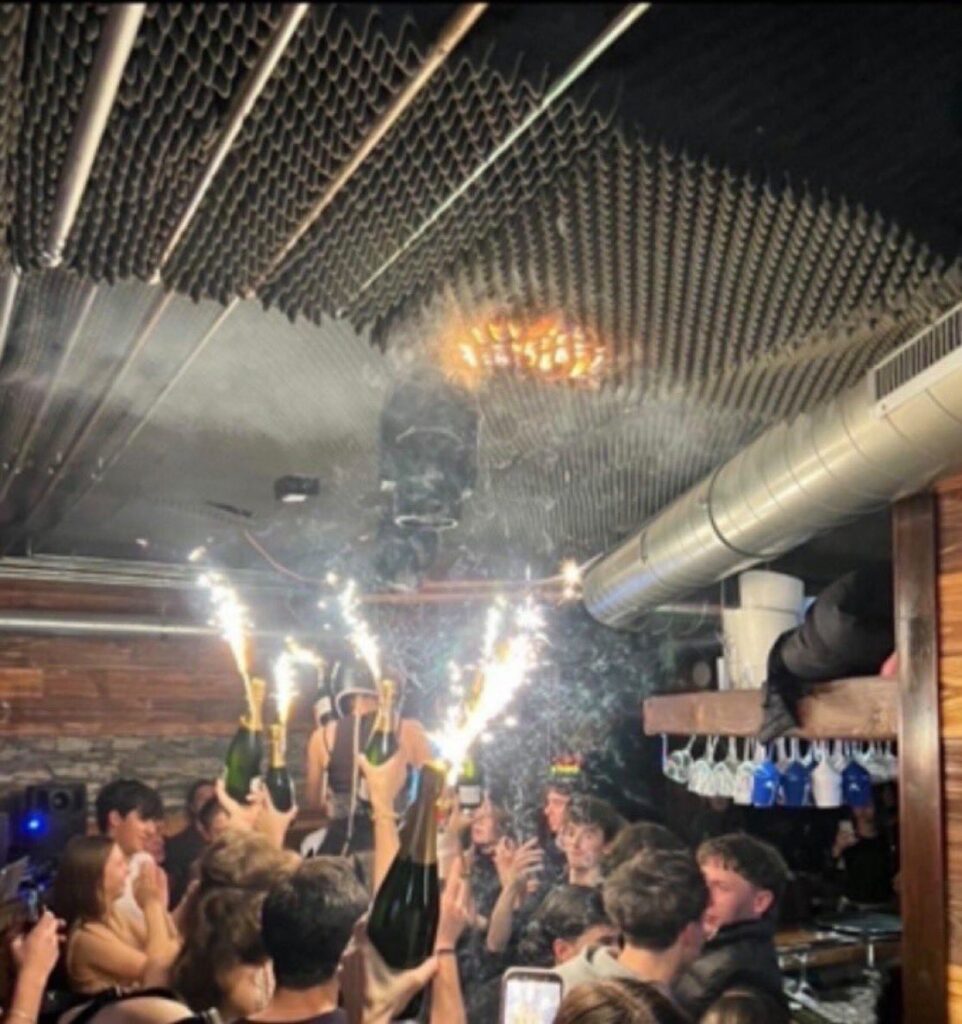
Just after 1:30 a.m. on New Year’s Day, fire ripped through Le Constellation, a crowded bar in Crans-Montana (Valais). Authorities report about 40 people dead and around 115 injured, many with severe burns.
Witness descriptions point to a familiar pattern: flames spreading rapidly in a confined, busy space, with evacuation turning chaotic as hundreds tried to exit through narrow passages. Investigators have ruled out a deliberate attack and opened a full criminal investigation; identification of victims is expected to take time, with forensic teams using medical methods such as dental and DNA checks due to the severity of burns.
Colectiv (October 30, 2015): pyrotechnics, flammable foam, toxic smoke — then a national reckoning
At Colectiv in Bucharest, a concert by Goodbye to Gravity ended in disaster after indoor pyrotechnics ignited highly flammable acoustic foam, producing toxic smoke and a rapid flashover. 64 people died, and 146 were injured.
Colectiv did not remain a tragedy “only” in the criminal file. It became a national scandal about corruption, permits, inspections, and the gap between paper compliance and absolute safety. Protests filled the streets, and political leadership fell under public pressure.
Judicial aftermath: convictions, compensation, and the District Mayor reversal
What many outside Romania forget is how long Colectiv’s legal aftermath dragged on — and how contested accountability remained even after “final” sentences.
In May 2022, the Bucharest Court of Appeal delivered a final ruling in the Colectiv case, sentencing multiple defendants to prison. Among those punished were:
- Colectiv’s owners, with the heaviest sentence at 11 years and 8 months, and other owner sentences of 8 years and 6 years and 4 months.
- Pyrotechnicians, sentenced to 6 years and 10 months.
- Fire-safety (ISU) officers/inspectors, with sentences reported at 8 years and 8 months each.
The ruling also reinforced the principle that institutional failure carries a price: compensation was ordered at tens of millions of euros to victims and survivors, alongside payments tied to hospital costs and treatment.
Mayor: convicted in 2022, acquitted in 2023
The most politically charged element was the fate of Cristian Popescu Piedone, the former Sector 4 mayor (later elected Sector 5 mayor). He was sentenced in May 2022 to four years in prison for his role in the permitting/authorisation chain, and served more than a year.
Then came the twist that reignited public anger: in June 2023, Romania’s High Court acquitted Piedone and ordered his release. The decision effectively reversed one of the case’s highest-profile convictions. It reopened the argument Romanians have had since 2015: who, precisely, is responsible when a venue operates “legally” on paper but is deadly in reality?
Consequences that outlived the courtroom
Beyond prison sentences, Colectiv reshaped Romania’s public life:
- It accelerated fire-safety debates and enforcement pressure on venues across the country.
- It entrenched public distrust in inspection regimes and “authorisation culture”.
- It exposed the painful cost of weak emergency preparedness and burn-care capacity — a point repeatedly raised in the years after, as survivors’ medical outcomes remained part of the national conversation.
Why the Crans-Montana echo feels so close
Crans-Montana and Colectiv are not identical cases. But the structural risk profile is hauntingly similar: crowded nightlife, combustible interiors, ignition sources treated as “harmless” in the moment, and evacuation routes that fail when the room turns.
A decade after Colectiv, the lesson remains brutally simple: if a venue is packed, enclosed, and finished with flammable materials, “one spark” is not a metaphor. It is a predictable failure mode.

