

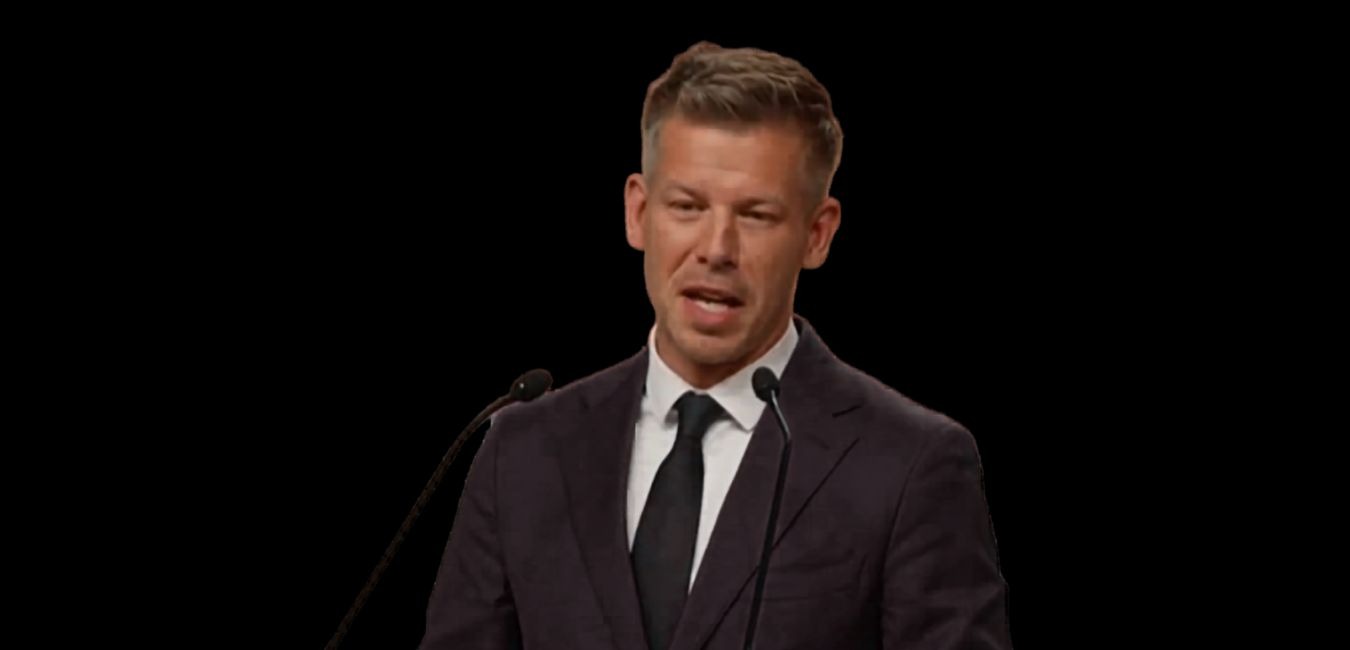
Victorious in Hungary’s parliamentary elections of April 12, 2026, Péter Magyar wasted less than 24 hours before raising serious red flags about his future government’s relationship with Romania. At his first international press conference, the Tisza party leader used the term “Partium” to describe territories within Romania’s borders — a formulation with strong irredentist overtones — and announced he was calling Kelemen Hunor, leader of the UDMR (Democratic Alliance of Hungarians in Romania) and a senior partner in Romania’s current governing coalition, to consultations in Budapest.
The Background: Orbán Backed Simion, Magyar Marched to Oradea
You can find the irredentist term at around 21.30 in the press conference below.
Hungarians living in Transylvania when he was supporting the Romanian George Simeon candidate. We decided to walk to Oradea, Partium, which is in Romania and we did 1 million steps on foot going through the smallest villages in Hungary and in Transylvania to our sisters and brothers outside the borders.
Premier Elect Peter Magyar using irredentist term Partium in referrence to Romanian territory
The chain of events began with Viktor Orbán’s speech at Tihany Abbey on May 9, 2025, in which the outgoing prime minister expressed support for George Simion, winner of the first round of Romania’s presidential election. Magyar immediately framed this as a betrayal, accusing Orbán of having sold out the interests of ethnic Hungarians living outside Hungary’s borders by backing a candidate whose past gestures — including dancing on the graves of Hungarian victims — Magyar described as an unforgivable offence against Hungarian historical memory.
In direct response, on May 14, 2025, Magyar launched the “One Million Steps” initiative, announcing he would walk from Budapest to Oradea. He completed the march on May 24, delivering a speech in the courtyard of Oradea Fortress, in front of the statue of Saint Ladislaus — a carefully chosen piece of medieval Hungarian symbolism on Romanian soil.
“Partium” — Anything But a Neutral Term
What caught analysts’ attention was not the walk itself, but the language Magyar chose to frame it. At his first international press conference after his election victory, he declared: “When he supported Romanian candidate George Simion, we decided to walk to Nagyvárad, Oradea, in the Land of Partium, which is in Romania.”
“Partium” is not a neutral geographical term. Historically, it referred to territories belonging to the Kingdom of Hungary — encompassing what today are Bihor, Satu Mare, and Arad counties, and parts of Maramureș county — and has no equivalent in Romanian historical geography. Its use by a politician about to lead the Hungarian government, to describe sovereign Romanian territory, carries unmistakable irredentist undertones.
The campaign to promote the “Partium” concept has followed a recognizable pattern over recent years: first the construction of an identity, complete with a freshly invented flag for a region that never existed as a distinct entity, with maps drawn by specialists at institutions funded by Budapest — including, in at least one documented case, bearing the logo of Hungary’s Ministry of Agriculture. A newly elected Hungarian prime minister’s adoption of this terminology is no slip of the tongue. It is a political signal.
Kelemen Hunor Summoned to Budapest
Within hours of his electoral victory, Magyar made a move that raises serious diplomatic questions. He announced he had spoken by phone with UDMR leader Kelemen Hunor and that consultations would continue in person the following week, in Budapest.
Kelemen Hunor is not a minor political figure. He is the long-standing president of UDMR, the party that holds three ministerial posts in Romania’s current governing coalition, including the Deputy Prime Minister position held by UDMR’s Barna Tánczos. UDMR is a constituent part of a sovereign state’s government. Being summoned for political consultations to a foreign capital by a newly elected leader of a neighbouring country is not standard diplomatic practice — it is the kind of gesture that treats officials of a sovereign state as subordinates answerable to Budapest.
Magyar framed the call diplomatically, saying he would tell Hunor he holds no grudge and that the conversation would focus on what they can do together for Hungarians in Romania, improving economic and cultural cooperation. The words are conciliatory. The framework is not.
A Pattern Worth Watching
Magyar built his entire symbolic offensive on the premise that Orbán betrayed ethnic Hungarians in Romania by backing Simion — a logic that turns Romania’s internal politics into a variable in Hungary’s electoral game. He accused UDMR leadership of participating in a smear campaign against him among Transylvanian Hungarians, funded by Hungarian taxpayer money, stating that the same party propaganda, financed by Hungarian taxpayers, operates in Romania.
In other words, Hungary’s incoming prime minister considers the funding of political activity within a neighbouring sovereign state and the summoning of that state’s coalition partners to his capital perfectly normal behaviour. For anyone who has followed the irredentist drift in Hungarian political culture over the past two decades — from autonomy maps to Partium flags to Orbán’s stadium-building across the border — the continuity of method, if not of style, is hard to miss.
Magyar won a two-thirds parliamentary majority — enough to amend Hungary’s constitution. His relationship with Romania, with UDMR, and with the broader question of Hungarian minorities will be one of the most sensitive files of the new government. The signals so far — the use of “Partium,” the symbolic march to Oradea, the Budapest summons for Romania’s coalition leadership — do not point toward a purely diplomatic approach. They point toward a style of politics that Bucharest would be unwise to ignore.

