

President Nicușor Dan is spending an unexpected extra night in the French capital after his return flight to Bucharest was repeatedly postponed, with Romanian officials citing a hard operational constraint: thick fog over Bucharest that made a safe landing at Henri Coandă (Otopeni) uncertain, even as Europe’s wider winter blast snarled air traffic across the region.
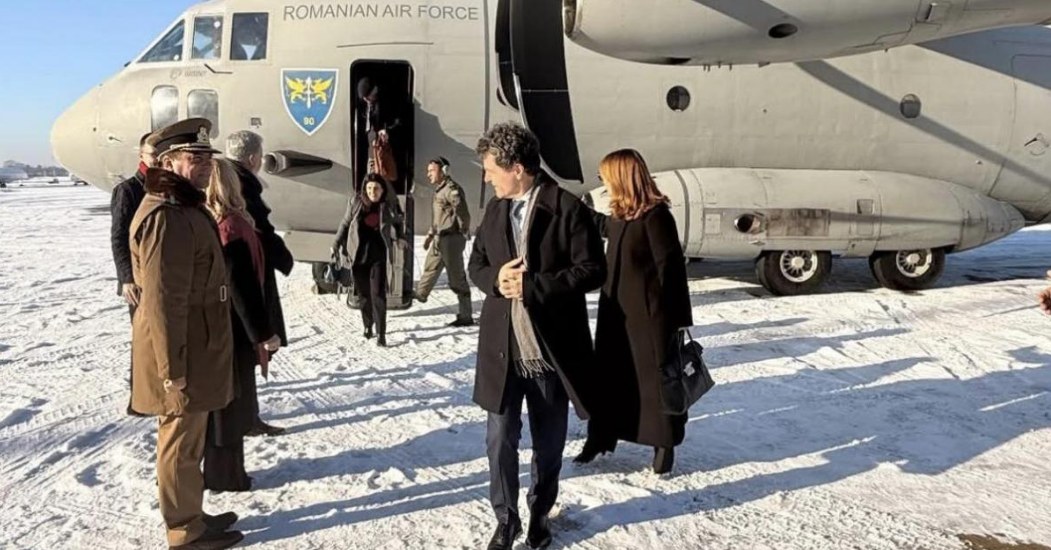
Dan travelled to Paris for a high-level “Coalition of the Willing” meeting focused on European security guarantees, Black Sea deterrence, and continued support for Ukraine. But the story quickly shifted from diplomacy to logistics: Romania’s head of state, accompanied by a press pool, was flown on a Romanian Air Force C-27J Spartan – an aircraft designed primarily for tactical transport, not for serving as a modern “presidential jet” with dedicated all-weather planning margins, redundant comms suites, and VIP-optimised operational flexibility.
The immediate blocker: Bucharest fog, not Paris politics
Romanian officials framed the delay in blunt aviation terms. When the destination airport cannot reliably accept arrivals, especially under reduced visibility, crews and dispatchers become conservative, particularly on a military transport mission carrying the president and an accompanying delegation.
While civil operators often depart and hold, divert, or reroute based on alternates and updated weather windows, state travel on a military platform tends to prioritise certainty: keeping the delegation together, protecting schedules and security protocols, and minimising the cascade of operational improvisation that comes with multiple alternates and split arrivals.
In practical terms, the decisive issue was not Paris’s refusal to depart “because the president was on board,” but Bucharest’s unreliability at that moment.
Europe’s winter front amplifies everything
The delay occurred against a broader backdrop of severe winter disruption across Western Europe. Snow and ice forced traffic restrictions, de-icing bottlenecks, and rolling reductions in airport capacity. Paris’s major airports operated under flight cuts and cancellations as crews cleared runways and managed airside safety. That environment matters because it shrinks the system’s slack: fewer available slots, more displaced passengers and crews, and a higher probability that any delay becomes a multi-hour or overnight problem.
So even if Bucharest’s fog was the key factor, the wider winter storm made it harder to “recover” the schedule quickly.
With journalists travelling alongside him, Dan’s waiting period became unusually visible. In a calm, informal exchange, he reportedly treated the disruption as a familiar Romanian winter story, sharing memories from Făgăraș of heavy snow, tunnels carved by children, and sledging routes that felt endless when you were young.
It was a disarming moment, but it also highlighted a structural point: modern presidential travel is not only about getting from A to B. It is about secure communications, resilience, and continuity of state functions, even while airborne, even when the weather collapses the schedule.
The deeper issue: Romania still operates without a true presidential aircraft
Romania’s “presidential plane” is not a single dedicated platform in the way many EU states maintain, an aircraft configured specifically for head-of-state transport, hardened communications, operational redundancy, and VIP mission standards. Instead, Romanian presidents have often relied on a mix of chartered aircraft and military aircraft, depending on the destination, urgency, and availability.
The C-27J Spartan is a capable aircraft, but it is not built to be a flying presidential office. It is a workhorse: practical, rugged, and reliable within its design envelope. What it is not: a purpose-configured strategic transport for head-of-state missions that must remain robust under tight weather minima, shifting diplomatic schedules, and high-security comms requirements.
That gap becomes obvious when a routine weather barrier, fog at the destination, turns into a headline about a president “stuck” abroad.
Budget reality versus state capability
Dan has repeatedly signalled that Romania needs a modern solution for official travel, including secure communications and predictable mission readiness, but the political reality is that any “presidential aircraft” debate instantly becomes a referendum on optics: costs, symbolism, and accusations of luxury spending.
The result is a familiar Romanian pattern: the state pays for the consequences of indecision in small instalments, inefficiency, schedule fragility, occasional embarrassment, rather than making a single, politically risky decision to build a proper capability.
Officials indicated the delegation would return to Bucharest as soon as landing conditions allow and a safe operational window opens. Even if the delay is measured in hours rather than days, the incident leaves a clear takeaway: Romania’s top-level mobility is still treated as an improvised arrangement, adequate until it isn’t, and then suddenly very visible.
In a week dominated by European security messaging and Black Sea deterrence discussions, the image of a president grounded by basic weather limitations is not catastrophic, but it is instructive. A country can talk strategy at the table, yet still lack the mundane logistical infrastructure that modern statecraft quietly depends on.

