

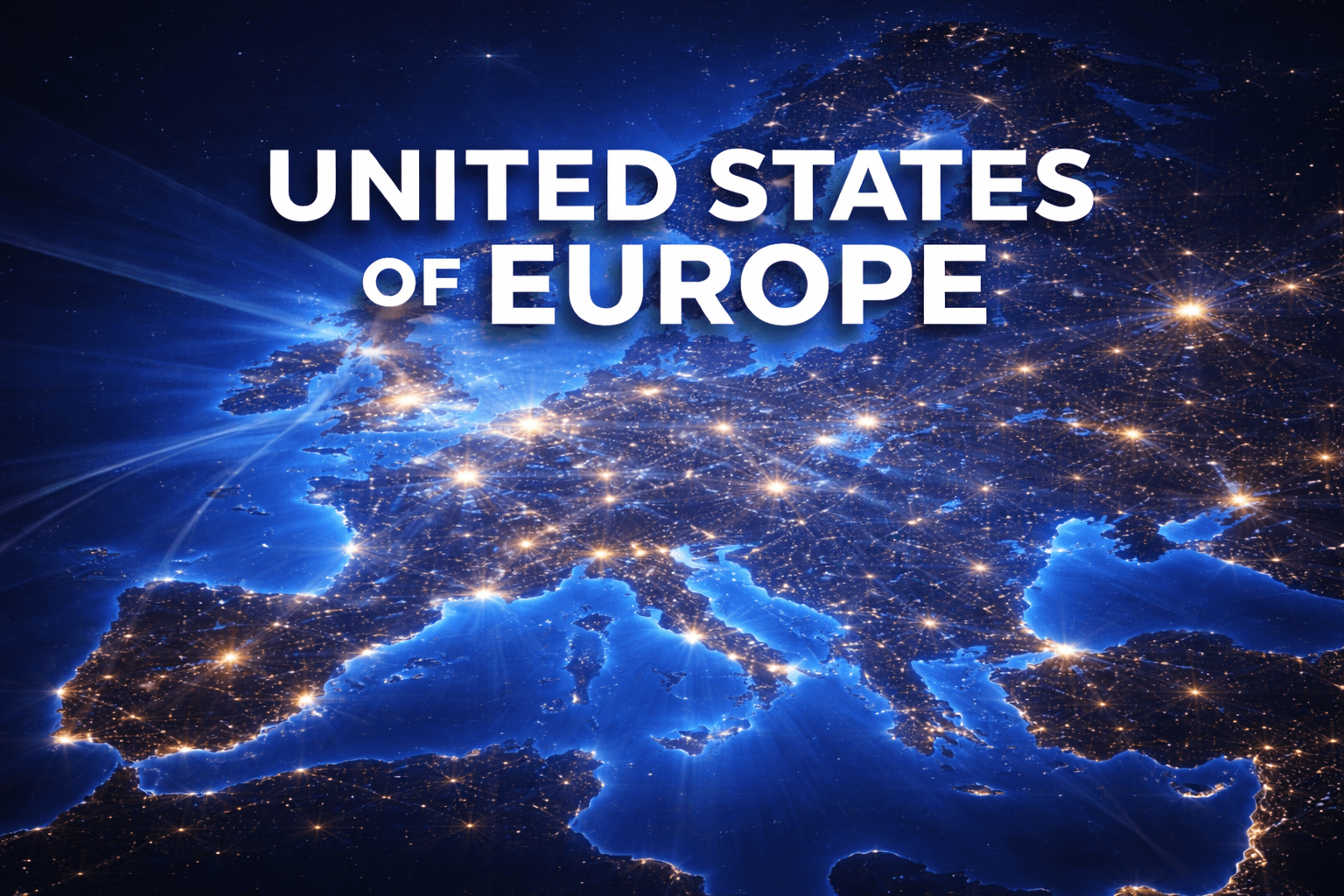
Former Romanian President Traian Băsescu has issued a blunt warning about Europe’s future security: without deep, accelerated integration leading to a “United States of Europe” within the next decade, the European Union will not be able to protect its citizens.
Speaking on B1, a Romanian television station, Băsescu argued that Europe’s current model is no longer sufficient for the geopolitical reality unfolding around it. In his view, the EU must stop treating federalisation as a theoretical debate and start treating it as a major political project with a clear deadline.
He said that in ten years, Europe must reach a level of unity comparable to a true federal structure, otherwise the EU will remain too fragmented to respond effectively to threats and protect its population.
Europe’s security model is no longer enough
Băsescu emphasised that European leaders made a strategic mistake by assuming the permanence of US backing without factoring in political shifts in Washington. In this reading, Europe has relied for too long on a security guarantee that could become unpredictable depending on American leadership and domestic priorities.
His core argument is that Europe’s strategic comfort zone is ending, and the EU must begin acting like a unified power rather than a collection of separate national positions.
Keeping legitimacy in global frameworks
In the same context, Băsescu supported the European Council’s decision not to join a peace structure proposed by Donald Trump, warning that parallel political mechanisms could weaken the legitimacy of the United Nations at a moment when global institutions are already under stress.
For him, Europe should remain anchored in established international frameworks rather than validating alternative structures that might undermine them in the long run.
Building EU-level defence capacity
Until Europe builds real political and military unity, Băsescu argues, it must prepare for scenarios in which US support is limited, delayed, or conditional. That includes developing European command structures capable of coordinating member-state forces independently, ensuring deterrence and rapid response even in an unstable transatlantic climate.
The message is direct: Europe needs an operational defence backbone of its own, not just political statements.
Ukraine changes the enlargement logic
Băsescu also pointed to Ukraine’s likely accession path as a turning point for EU enlargement, arguing it will reshape the rules and expectations for future candidates.
Once Europe sets a precedent by advancing one state under exceptional security circumstances, he believes it will be forced to face the longer-term consequences of that choice across the entire enlargement process.
Turkey’s role in a harder Europe
He then raised one of the most sensitive topics in the EU debate: reopening accession talks with Turkey. According to Băsescu, Turkey’s blockage is driven more by political hesitation than by technical impossibility, and democratic concerns could be handled through structured monitoring mechanisms similar to those used in other cases.
But his argument is primarily strategic. If NATO’s credibility were to weaken significantly, Europe would face enormous pressure to build autonomous deterrence and defence capacity, with major financial costs, and Turkey’s military strength would become a factor Europe could not afford to ignore.
The “double standards” problem
Băsescu concluded by criticising what he described as double standards in the enlargement process: if Europe is ready to accelerate Ukraine’s path despite known vulnerabilities, then Turkey should not be dismissed automatically on principle.
The warning behind the entire message remains blunt: Europe is running out of time to become a coherent power, and the decisions ahead will be hard, costly, and unavoidable.

