

On New Year’s Eve, Romania does what it always does: it watches the clock, it watches the fireworks, and some of us watch the lottery.
But this year, the draw itself became the story.
Two 6/49 draws took place on the same night, one was regular, and one was extra for New Year’s Eve – two sets of six numbers. And viewers immediately noticed something that looks, to the human brain, like the kind of coincidence that “shouldn’t happen” on live television.
Four numbers repeated. Not one. Not two. Four!
The numbers that triggered the debate
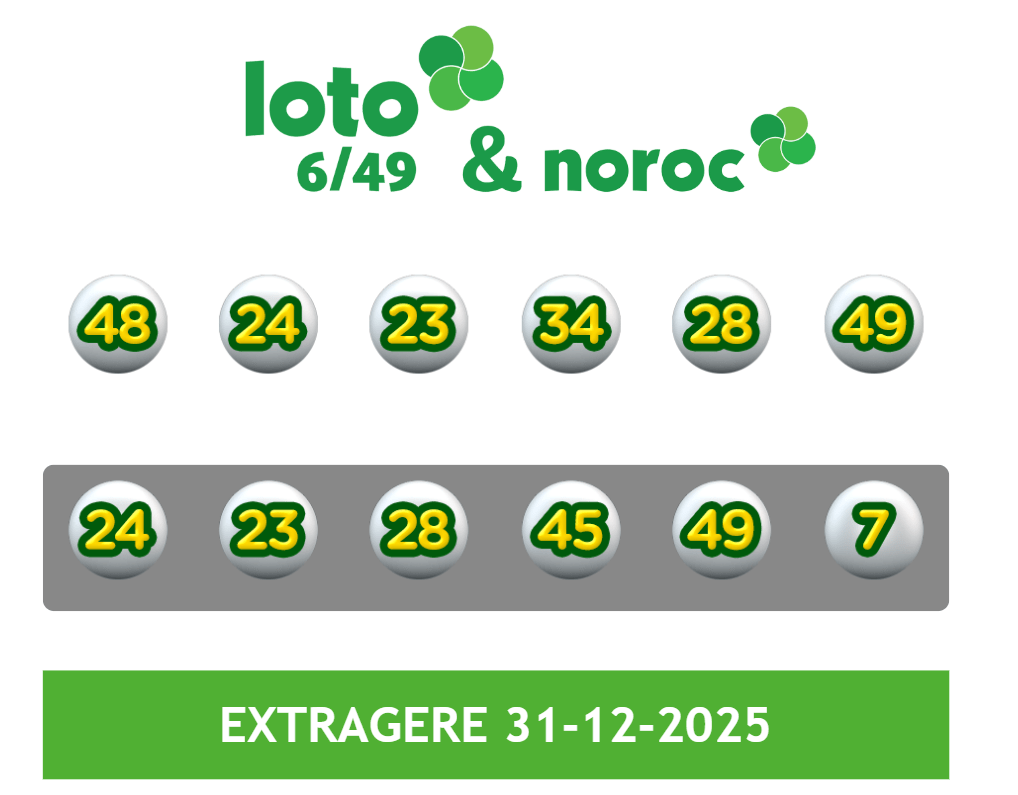
The results shown for the two draws:
- 24, 23, 28, 45, 49, 7
- 48, 24, 23, 34, 28, 49
The overlap is obvious: 24, 23, 28, 49.
And that overlap is precisely why people reacted so strongly: the human mind is built to treat obvious patterns as signals, not as noise.
But lotteries are noise machines by design. The only honest question is: how often should this kind of “noise” appear?
The actual probability: rare, not impossible
In 6/49, each draw is a random selection of 6 distinct numbers out of 49.
If you “freeze” the first draw and ask what the second draw would have to do to match exactly four of the six numbers, the probability is:
- ≈ 0.0969%
- roughly 1 in 1,032
If you ask for the chance of matching four or more numbers (4, 5, or all 6), you get:
- ≈ 0.0987%
- roughly 1 in 1,013
In everyday language, a four-number overlap is unusual enough to feel shocking, but common enough to happen sometimes in real life, especially over long periods of draws and public attention.
The reason people jump to suspicion has less to do with the lottery and more to do with how the brain processes coincidence.
A one-in-a-thousand event sounds like it belongs in a documentary, until you remember how many opportunities exist.
A single four-number overlap does not prove manipulation. If someone wanted to evaluate integrity statistically, they would look for patterns that persist over time, such as:
- unusually frequent high-overlap results across many draws,
- systematic bias toward certain numbers over long periods,
- repeated anomalies tied to specific conditions (equipment, ball sets, procedural deviations),
- or operational red flags that reduce trust in the process.
The difference matters: coincidence is a moment, while bias is a pattern.
So… rigged or not?
Based on the numbers alone, this outcome is fully compatible with chance.
It is a low-probability event, but not “miracle-level” low. It sits around 1 in 1,000, which is precisely the sort of probability that occasionally punches through the noise and looks outrageous on a night like New Year’s Eve.
But there is another reality lotteries must face:
People don’t buy tickets based on probability. They buy tickets based on belief.
And belief depends on trust.
When lotteries become the subject of viral suspicion, even if the math is clean, it reveals something important: public confidence is fragile.

