

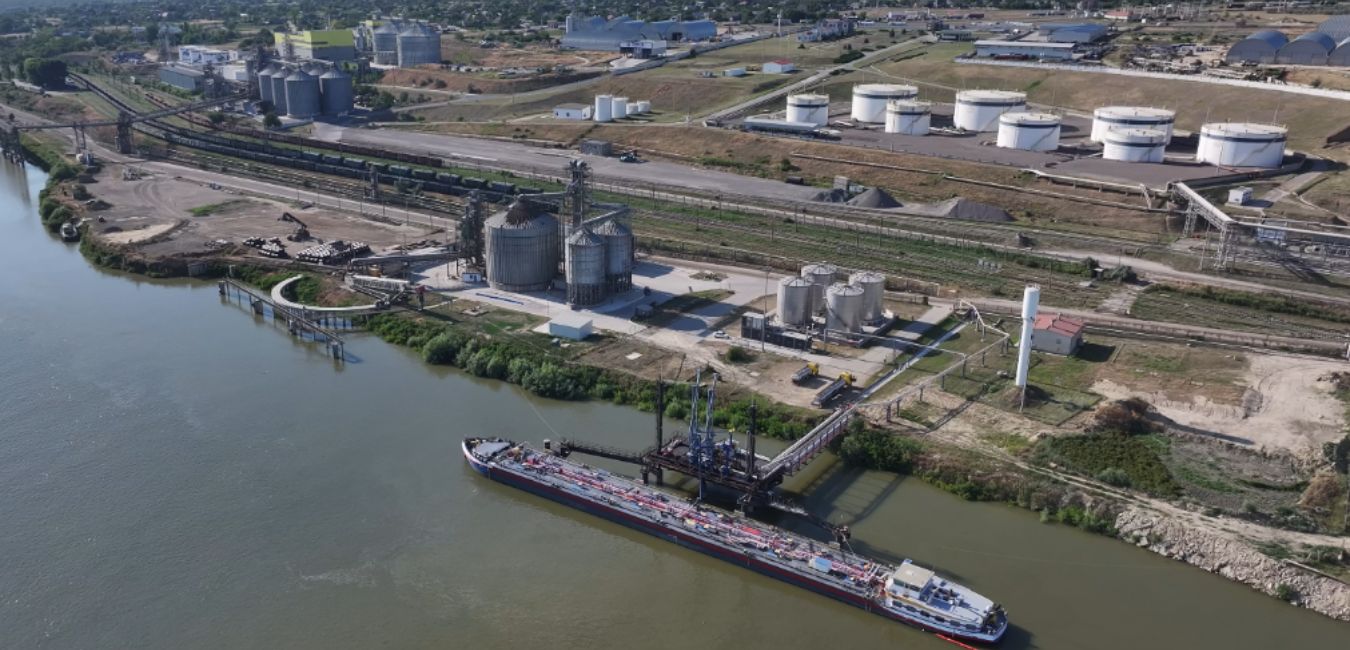
Romania is moving to anchor its influence over one of Moldova’s most strategic logistics assets after the National Company for Maritime Ports Administration SA Constanța (Port of Constanța) agreed to acquire Danube Logistics, the operator of Moldova’s Giurgiulești International Free Port, from the European Bank for Reconstruction and Development. The share purchase agreement was signed on December 31, 2025, and the Romanian port authority announced approval on February 12, 2026, with the transaction expected to close imminently.
This is not a symbolic buy. Giurgiulești is effectively the Republic of Moldova’s maritime gateway: it sits on the country’s short strip of Danube riverbank, bordering both Romania and Ukraine, and it handles more than 70 per cent of Moldova’s waterborne imports and exports. In practical terms, whoever controls the operator controls a key valve in Moldova’s supply chains for fuels, grains, construction inputs, and general cargo flows.
For Romania, the logic is straightforward: it extends the gravitational pull of the Port of Constanța beyond the Black Sea coastline and deeper into the Danube Basin, consolidating a Romanian-managed corridor that links sea, river, rail, and road routes. Giurgiulești also sits at the edge of the region’s most sensitive trade geography, where war-driven route shifts, sanctions risk management, and the need for redundant corridors have turned ports into strategic infrastructure rather than just commercial facilities. The port is also positioned to play a practical role in the logistics layer of future reconstruction in Ukraine, where bulk commodities, building materials, and fuels will require flexible routing options across the wider Black Sea–Danube system.
The transaction follows a competitive tender process designed to identify a long-term strategic investor, after what was described as strong international interest in the asset. That framing matters: it signals that the buyer is expected to invest, not merely extract cash flow. Port of Constanța has committed to long-term capital spending aimed at capacity expansion, infrastructure upgrades, and tighter integration into its wider Black Sea trade network.
From Chișinău’s perspective, the headline is economic resilience with a political subtext: the country’s most important waterborne trade outlet will now be operated by a Romanian state-owned entity, strengthening day-to-day economic interdependence between the two states. The seller says that under its ownership the port recorded higher throughput, revenues, and profitability, leaving it with a stronger foundation for the next investment cycle.
At the operator level, Danube Logistics’ management is positioning the change as an acceleration rather than a disruption, promising seamless operations and synergies with Constanța while pursuing expansion, new berths, land development, and broader services for shippers. If execution matches the stated plan, Giurgiulești is likely to evolve from a national gateway into a regional node—one that can attract more transit volumes and investment at a time when the Black Sea–Danube interface is being re-priced by geopolitics, security costs, and the coming reconstruction economy.

