

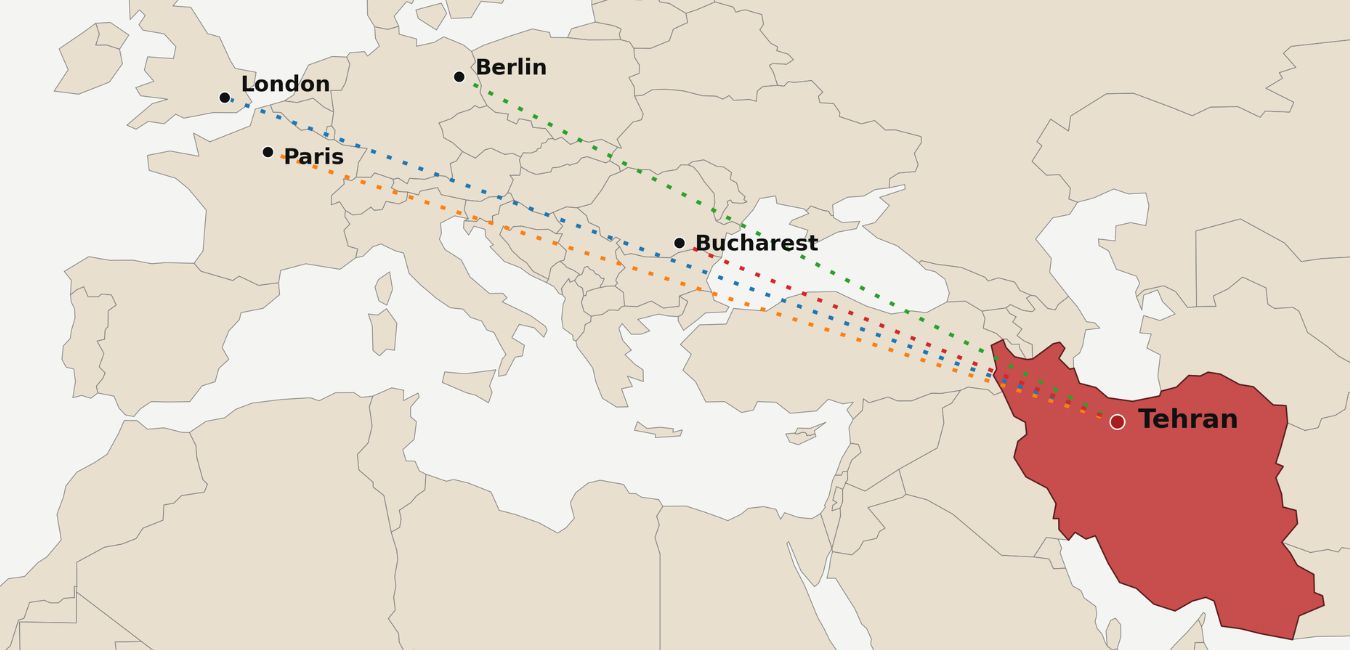
Iran’s reported launch of two intermediate-range ballistic missiles toward Diego Garcia should end one of Europe’s most comfortable illusions: that this war is far away, containable, and strategically separate from the continent itself.
Whether the missiles hit their target is not the central issue. The issue is that a threshold was crossed. A capability was demonstrated. A message was sent. And that message was not aimed only at Washington, London, or military planners in the Gulf. It was aimed at everyone still pretending that distance is protection.
If Tehran can launch at roughly 4,000 kilometres today, only a fool would build policy on the assumption that 5,000 kilometres is somehow out of reach tomorrow.
Romania’s President Nicușor Dan chose reassurance over reality
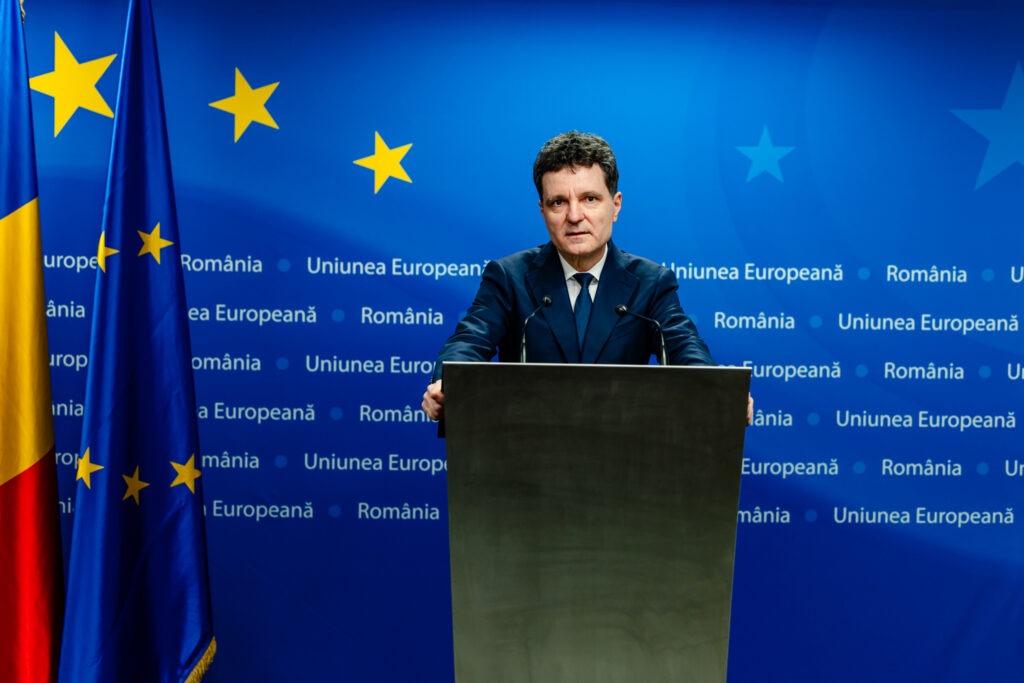
This is what makes President Nicușor Dan’s recent declarations look less like calm leadership and more like strategic frivolity.
He said Romania was completely safe and under no direct threat. That kind of absolute language is politically convenient, but it is also dangerously fragile. It sounds firm for a news cycle, then collapses the moment reality outpaces the statement. And reality has moved fast.
The problem is not that a president should avoid panic. Of course, he should. The problem is that he chose the rhetoric of certainty in a security environment defined precisely by uncertainty. When missile range expands, when escalation spreads, and when European capitals are openly discussed within strike distance, the responsible language is caution, preparedness, and deterrence, not blanket comfort.
Romania is not outside the new threat range. But no other capital city is!
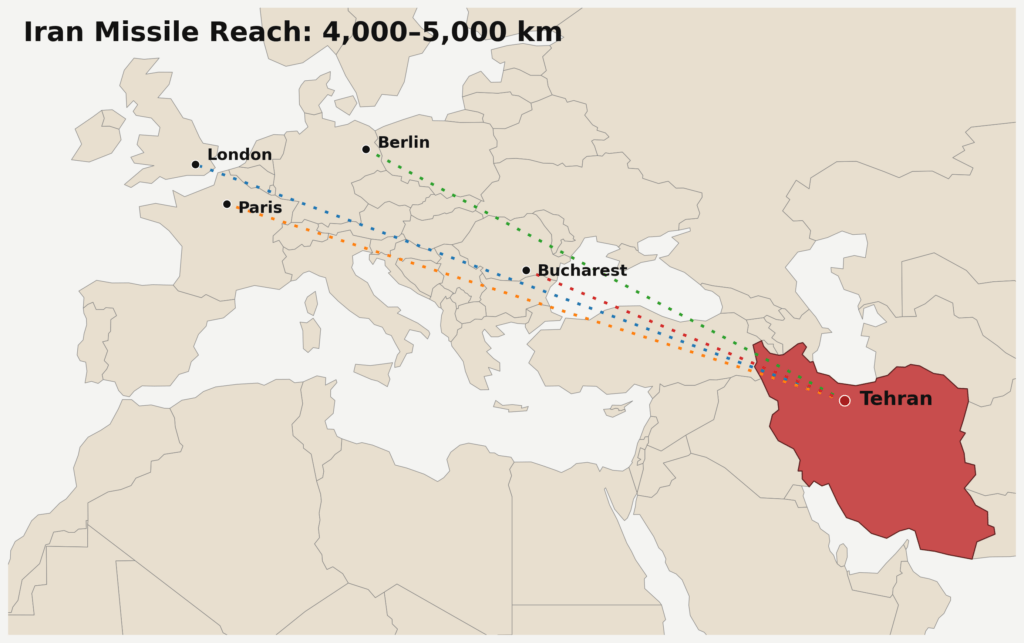
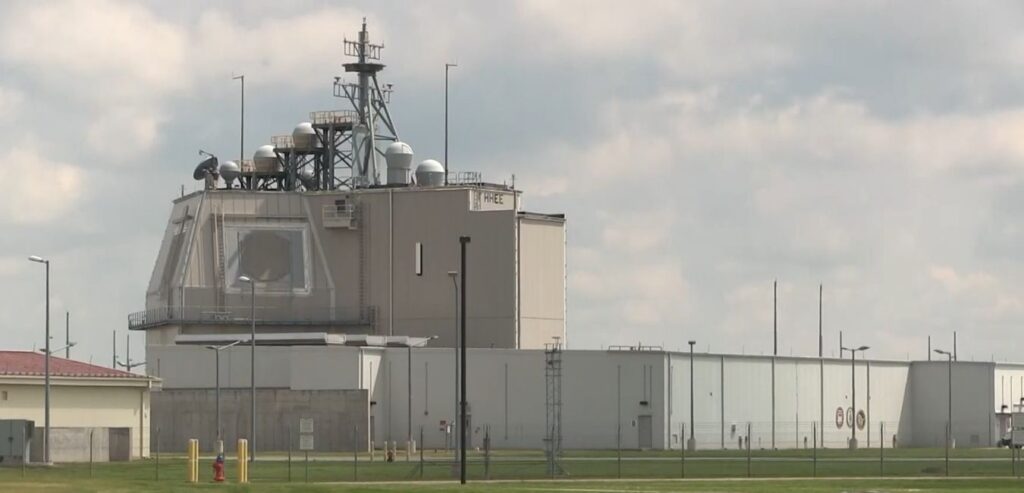
Romania cannot speak about itself as if it exists outside the strategic geometry of this war. It is a NATO state on the eastern flank. It hosts critical allied infrastructure, such as the infamous Deveselu rocket site. It matters militarily, geographically, and politically. That alone makes it relevant. Add the fact that Iran has now demonstrated a much longer reach than the one it spent years publicly normalising, and the old language of “no direct threat” begins to sound unserious.
No, that does not mean Romania is about to be hit tomorrow, despite Iran’s recent threats that it considers Romania an aggressor. It means Romania is no longer entitled to the fantasy that this is someone else’s problem.
NATO protection is real, but it is not magic
NATO is not a miracle shield that makes geography disappear, missiles vanish, or escalation politely stop at the Alliance’s frontier. It is a military deterrent structure, not divine intervention. If a longer-range strike ever pierced Europe’s defences, the first reality would not be communiqués or treaty language, but destroyed infrastructure, burning airports, shattered energy facilities, paralysed logistics, mass panic, and cities thrown into emergency mode within minutes.
Bucharest, Warsaw, Berlin, Paris or Rome would not look “safe” in that moment simply because they belong to NATO. They would look like modern capitals hit by the failure of deterrence. NATO can retaliate, contain, and raise the cost of aggression to catastrophic levels, but it does not mean that no missile can fly, no building can fall, and no civilian population can be forced to live through the first hours of devastation.
There is another lazy reflex in European political communication: invoking NATO as if the very mention of the Alliance eliminates danger. NATO matters. American presence matters. Missile defence matters. Collective defence matters. But deterrence is not the same as invulnerability.
A country can be defended and still be threatened. It can be under the NATO umbrella and still sit inside an adversary’s strike logic. Serious leaders understand this distinction. Weak leaders blur it because the second version is easier to sell domestically.
That is exactly why phrases like “Romania is safe” should be treated with scepticism when the actual strategic environment is deteriorating in real time.
Europe has run out of geographic excuses
The deeper issue is European complacency. For too long, Europe has behaved as if danger only becomes real when it arrives physically, visibly, and unmistakably on European soil. Until then, every escalation is treated as regional, external, manageable, somebody else’s problem.
That mentality is now collapsing. A 4,000-kilometre launch is not only a military event. It is a political event. It forces Europe to confront the shrinking distance between conflict zones and European vulnerability. It destroys the comforting fiction that the continent can remain merely an observer while the surrounding arc of instability expands.
No one in Europe is safe any longer in the old psychological sense of the word. That is the real shift.
The most dangerous lie is false certainty
The most irresponsible thing a European leader can offer at a moment like this is not caution. It is false certainty.
Citizens do not need theatrical panic. But they do need adult language. They need to hear that the world has changed, that security assumptions are being rewritten, and that comforting slogans are not a strategy.
Iran’s longer-range launch should be read as a warning shot to European political thinking as much as to military planners. And in that context, Nicușor Dan’s confident assurances already look obsolete.
Because once a regime demonstrates that Europe is within reach, the debate is no longer whether the continent is “safe.” The debate is whether its leaders are serious enough to admit that it is no longer.

